

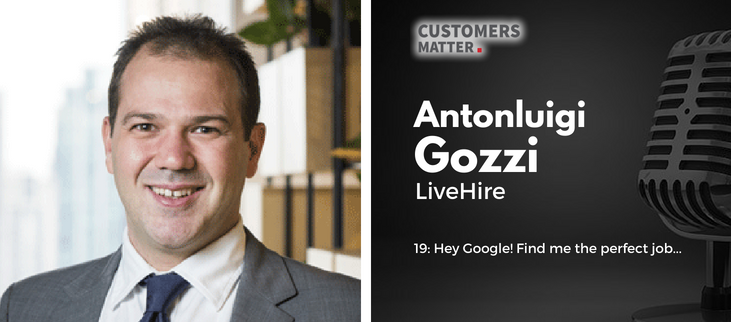
Imagine never applying for a job again. Instead, you’ll join a talent community where you’ll be deeply understood not just for the skills you possess but the values you hold. And once there, you’ll be matched with the perfect opportunity in your ideal company.
As the cofounder and chief products officer of LiveHire, an ASX listed company, Antonluigi Gozzi (better known as Gigi) is developing his company’s technology to do just that. He also believes it’s only a matter of time before we all have an AI-powered virtual assistant helping us as well…
John: So Antonluigi Gozzi, better known as Gigi, is the cofounder and chief products officer at LiveHire, now an ASX listed company that wants to change the future of work. The story of his company’s rise during the WA resources boom, subsequent listing and now drive to become a world leading technology business in the human resources sector is absolutely remarkable. And so is Gigi, he’s a true Renaissance man and Gigi, welcome to Customers Matters.
Gigi: Good morning.
John: I’d like to turn in a moment to how you founded LiveHire but first I’m hoping you could share a little of your personal story, where did you grow up, study, and how did you become so interested in the future of work and indeed how we go about finding jobs?
Gigi: I grew up in Italy, so I’m originally Italian and I acquired a significant education and then became an engineer. I studied engineering for about seven years and I was deciding between engineering and philosophy to tell you the truth, and I found engineering was quite challenging and probably I could back to philosophy afterwards, where the other way would have been much harder. So I became an engineer at 25 and started to travel the world and worked in Anglo Saxon countries. I used to speak German and Spanish and Italian of course and so I left English the last thing to do so I knew I had to do that, and so at that time I came to Australia to learn English and to work in an English speaking country.
John: I mean the English might say you don’t learn to speak English in Australia.
Gigi: No they don’t think I speak English at all. And I really enjoyed being in Australia and exploring the world and really learning how the world is becoming all connected. And that globalisation really inspired me to to jump in the world of technology really.
John: So how and when did you and your cofounder Mike Haywood meet and how did you come to found LiveHire? You’ve got this philosophy and engineering background, you find yourself in Australia, you got interested in technology but how did that lead to the founding of a company?
Gigi: I believe that with technology today as you said there’s a bit of renaissance where in the hands of everybody, every engineer who can code, you can produce product that gets used by billions of people, literally. So there people have an infinite power to what I call engineer the work through technology and when you do that you can create things that never existed before as scale and that’s what’s new about the last ten, twenty, thirty years of technology and this is getting really polarised and is changing everything we do. And I have the benefit of being one of those people that were on the cusp, on the cusp of the before and after, before technology, after technology, before mobile phone, after mobile phone and that makes you want to change things and to bring something that is not there yet. So when I met Mike Haywood, he was a entrepreneur in Australia’s, been in booming time for thirty years so, and not just economic boom is ideas boom, people believe they can do a lot. And so with him we looked at probably about fifty or sixty potential businesses to build from scratch all based on technology, and to tell you the truth lots of those exist today in some form but none of them was big enough or a scale enough for us. So one day I said to Mike let’s look at the world slightly differently. The biggest industry in the world is people so, and that industry hasn’t been really transformed by technology yet. Travel has, banking has, and you name it, but people and hiring, and so looking a bit deeper in terms of meaning of your life or my life of your life is work is so important, if you think about I remember when I wrote the first presentation of what a business idea was was like forty pages. And I was trying to map the various technology that exists in the world and how did I go. And the word work defines our mental health, mental state and so on and so I thought if we could do something for technology that empowered the flow of the world’s talent that leads you to your next step in your career, that would have been great.
John: And it’s amazing, I mean I love the concept of LiveHire, a software platform that essentially allows anyone to identify a company they may wish to work for even when they’re not looking for a job or that company’s not hiring. It kind of enables both parties to understand each other and makes for such an improved hiring experience…
Gigi: Yes.
John: whether you’re the company or the candidate. But how did that idea take shape?
Gigi: So we studied intensely for about seven months on the business model, what we were wanting to test, how would it work, we knew we were onto something that was just simple, the idea was simple, the concept was simple, it wasn’t done and so you know you’re onto something when everybody says “yep, I wish that existed”. But then you need to think about how it’s going to work. Is it a marketplace, is it an auction site like eBay started, is it a job board in this industry, how will you change, how you bring technology for a future state that you want to create. And so again thinking about technology is the word pervasive, where technology’s where we’re bringing people together. So what I believe technology defines behaviours through technology right? So whichever you use and so for human do best is communication, interaction and so any technology that empowers people to interact, gain life, or it gains life of itself. Think about AirBnb, you’re not talking to bookings.com and to a machine please find me a room. You’re actually talking to Wendy on the other side of the world who has a house and you know wants to invite you into her house. So those technology I believe create ecosystems, and so then we started designing a technology from the ground up, completely different from anything that existed. And we knew that it will be a long journey, you don’t just go to an agency and say built a website and then you’re a successful business. That doesn’t really work like that. You might have to start like that but you need to have a very strong vision how this technology is going to be different from the ground up so we’re building a network really a technology based network.
John: So thinking about what’s wrong with the way we find work today, tell me what is your vision for the future and I think this was the vision that started to take shape as you grappled with this so what is wrong with the way hiring happens and what’s your vision for the future?
Gigi: The fact is nothing is truly wrong, things just change and change very slowly and then change very fast. And so I think that what’s hard is that in a world that’s hyper connected and work at a very high speed, companies are changing faster than people’s skills can change. Some people can redeploy themselves very easily and some other people just get left behind. We’re starting to enter now the era of mega rounds of firing people, the largest economic telecommunication company in Australia this week is firing a third of its workforce. What that means is that a third of your people weren’t actually productive, their skills are not what you need anymore. So rather than looking from a business perspective just cut people you need to think about what about these people. You can’t just cut the person, you can cut a PNL, but this person has family life, mental health as an indication, so the what’s wrong is things are moving faster than people can adapt to. So what you need to do, you need to create some version of future visibility for every individual and every company or who I’m establishing relationship with and then let some of the artificial intelligence on that career path being defined by your future objectives.
John: I mean this is a really interesting case study. As you say Telstra’s just announced it’s going to sack eight thousand people, in fact nine and a half thousand people…
Gigi: Correct.
John: …but they’ll hire another one and a half. So how does LiveHire help those eight thousand people potentially?
Gigi: Is very good question. We would love to help those people. Those people first need the help of of a whole network. LiveHire has call a hundred clients who are looking for people and the way those people are going to match is the interesting part. What a company wants, wants visibility of what’s possible, and I can guarantee you that a portion of those people who are very right for one company another person would be very right for another company. And once you establish all those connections then you let people do what they do best, meet, find their future employer, and find their future employee. At LiveHire we believe even from the company you’ve got to help both. You don’t help both, you don’t help anybody. First you need to help the company find the right person and then you need to have the person find the right company. Well what’s that? You need to make it visible for both of them. In the past job boards were the only way to find a job, and that’s changed in many countries in the world because it’s an advertisement based model, it’s like often we say is like advertising of who wants to sell me a car. And you’re going to get hundreds of cars but most of them are not what you want. You want to go somewhere where you are going to exactly find what you need. I say I want a Golf, that’s blue, and it’s got these kind of wheels and so we open the visibility by creating private networks. So a private network is simply your network of people, that you want to work with you but it’s private so your information doesn’t go everywhere. As soon as that happens you lose control of your career.
John: I think that’s first grappling with LiveHire and its alignment of organisations and individuals and values and stuff I thought it’s almost like Tinder for business. What would you think of that description?
Gigi: The company that built Tinder built a lot of networks and actually the designer who worked there actually invent a lot of things that changed people behaviours from first he invented a scroll down to reload and then he invented a swipe right or left to make decisions. The company was based on defining behaviours and bringing people together and now he’s working currently on a mobility, human mobility, which is moving people from A to B. Those were profound changes, you just decide to apply them to something where there is a need. Just like Jeff Bezos didn’t want to sell DVD’s all his life or books he knew he wanted to bring people and merchants together. That example of Tinder is a very good example, wanted to bring people together on the convenience of wherever they are, whenever they want. We want to do the same for work, we want to bring people together wherever they are and whatever they want. What technology’s amazing at and that’s why we build a technology company is that one system can cater for an infinite amount of variables. So you can buy any book, I can find any book I want, I can find any place that I want to stay in, but the system is only one, but there’s an infinite cater for everybody. And so LiveHire needs to be the same is that centre system that can cater for any job and person.
John: So you’re the founder, the major shareholder and you’ve just appointed a CEO in Christy Forest for the next leg of your company’s journey. So where do you hope to take the company and what do you think it might look like in five years?
Gigi: We want to be a global technology company. We want this future where people can move through their career quite in a effortless way, they can continue to see potential opportunity in front of them. This requires us to bring all the major organisations in the world and in each country together to actually have, adopt this way of finding talent, and stay connected to talent. And we’re going to build technology that is incredibly intelligent and helpful and is on everybody’s devices every day.
John: You talk about a future in a way that’s fit for humans and you’re essentially though a technology company so I’m really interested in how you think technology will shape the future of work and whether it will shape the future of work for better or for worse?
Gigi: That is a big debate out there and I don’t think it’s going to get resolved very quickly. I’m not a futurist and I don’t believe in futurist, I believe that is ‘now-ist’, you need to be in the now because all the trends you can see are happening right now. And so what can you do now that’s better. I think technology helps for example Apple and Google would have spent billions of dollars, tens of billions of dollar on artificial intelligence. And the artificial intelligence is here, in the hands and pockets of every single person, you have twenty billion dollars, what’s the technology? That didn’t replace you, that didn’t replace your job, it works with you, it makes it better for you so over all we build technology to help people. But in this rapid world of change if you don’t stay with it, you will be left behind.
John: So Gigi we’ve spoken about technology and the role of technology but let’s get even sharper. Artificial intelligence, it’s the big buzz at the moment, what’s the role of artificial intelligence in the future of work?
Gigi: Artificial intelligence it’s fantastic. Companies like Google and Apple and lots of Chinese companies invested many many tens of billions of dollars in machine learning. Now that technology is available to everybody like us, to plug it in to any problem. And so we plug it in in the future of work and all of a sudden things like understanding what you want to do, matching you real time with the right opportunity, predicting what a company’s going to do next with your job. When is the time to look for somebody new, when is for you the time to look for something new and just understand your intentions, that’s what AI can do in the workforce. So basically the job of everybody is going to be partly relinquishing some control to some artificial intelligence. It’s going to make some decisions for you. And that’s a big step for everybody. But the way it will happen, it will happen just slowly through the various decision that you do every day and eventually you are going to become a little bit dependent on this.
John: So in a very practical sense if I’m a hiring manager, what does artificial intelligence mean for me and conversely if I’m someone looking for a job, how could artificial intelligence help me?
Gigi: If you look a couple of years ahead most likely some jobs they are quite commoditised let’s say, you just ask the computer, please find me a person for this role. The machine will go and find all your contacts, the people you have a relationship with, the people that are currently available and communicate to the right ones, book them in, sign a contract and the will be in the job the day after. And you don’t even have to do anything, maybe just make the final decision. And for people it’s going to be even more pervasive because all of a sudden I can ask my artificial intelligence assistant to help me, what should I do next? Actually when I went to meet the VP of Google for work he said the most common searched word about jobs is ‘jobs near me’. So people already are asking Google as your artificial intelligent assistant help me with this. And now they’re invested a lot, I will okay, what do you want to do, I want to have this job, which kind of company you like to work for, this one, how many years’ experience do you have, this much. Okay what about these five jobs are you interested? Yeah, why don’t you make an application for me, good. Here’s all your data so the future of automation, artificial intelligence is very clear and is very near.
John: I think it’s really interesting because as a potential candidate initially I thought that sounded very scary that a robot might be vetting me in effect or a artificial intelligent piece of equipment is learning and vetting me and I’m feeling scared about that but then suddenly what you’re saying is I could also use the artificial intelligence to vet the people that I might want to work for so really we’re both armed.
Gigi: Correct. It works because it works a scale. So if you think about Google the other day, he came out and didn’t say I built an answering machine for shops. They said now you can ask Google to book you an hairdresser, you will find one, it will find the right time, it will put it in your calendar, it will speak to the hairdresser reception and do that for you. So think about societal shift, they didn’t build an answering machine, they built an AI that talks and does things for you so they went for the masses not for the little business. So it will work both ways but they build what’s most applicable so yes, I think it’s more likely to help people en mass than helping each and every business.
John: For LiveHire what does this world of AI mean, what do you see it doing for your company and the companies that you serve and the people that you serve?
Gigi: It is very important because number one a company needs to have one system that end to end, understands all their data about people and their relationships. Then you use AI to provide very good matches and very good automation of processes so that the machine works together with the recruiter in symbiotic scenarios. Currently the machine is just a tool, it’s not intelligent. We bring intelligence in the platform you use to do all your recruitment and we allow people to provide all the information to a company privately so they can be seen in the right ways. So the questions we ask people is not just what do you do it’s what do you want to do, what makes you special. Write a piece of you know a piece of sentence and make us understand your objectives. Who do you know in this organisation; once we know a lot about you we can help the company with AI to really match opportunities in real time. And all of a sudden you get tap on the shoulders very often and you know your investment is paying off.
John: Gigi I think a lot of people underestimate how important it is to make the right hiring decision, how significant is it when you set about you know putting someone in a role do you think?
Gigi: At LiveHire we believe that hiring is by far the most important thing companies do., because hiring is a renewal of your organisation. In every three or four years you have turned over most of your organisation, that’s people and they define your future so hiring is the most important thing companies do. And the more we realise that the better it is for everybody. And therefore choosing the right person becomes a strategic decision. Think about what is the most important job of every manager? Picking the right people for their team. What is the most important job of a board? Picking the right CEO. So hiring is the most important part of every company but it’s also the most important part of every job. And so if you look at the world again a little bit differently, you want to pick the person, it’s very important, how do you do that though. It’s long, time consuming, what do you do, you need machine that gives you visibility, you need artificial intelligence, you need to have at your fingertips. And that machine is to understand not just people, it’s understanding their intentions. And so when you get to that point that will be fantastic and so simple and actually I want to add something else. Is not just about companies that hiring is the most important thing companies do, think about your personal life. Finding the right partner is the most important thing people do, finding the right friend. And so in life in general we are social animals, you want to find people that are right for you, for your organisation. And LiveHire helps you with that.
John: Fantastic, thank you.