

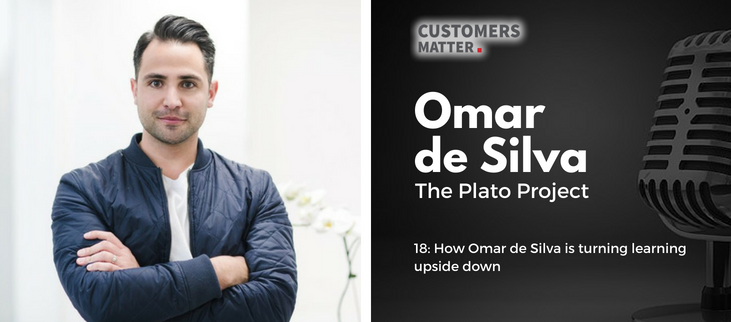
Omar de Silva first ventured into the business world by selling exotic lollies at school. Now, he has invented a new business school for entrepreneurs in the digital economy, which is turning the philosophy of learning upside down. He discusses his raw emotional journey through life’s ups and downs that gave rise to a very purposeful educational enterprise – The Plato Project.
John: So today I’m in Melbourne, in downtown Fitzroy. I’m joined by Omar De Silva. Omar is the co-founder and Executive Director of the Plato Project, which is a new business school driven to foster entrepreneurship and business leadership. The school here has a little bit of a feel of a Japanese ski lodge but I know this is not actually the school itself. It’s definitely a creative space Omar.
Omar: John good to see. Thanks for the chat. It is definitely a creative space. It definitely does have the feel of a Japanese ski lodge. It’s not by design it’s by inheritance, but it’s a talking point if nothing else.
John: Well I’m still looking for the sushi and sake but I hope that comes later.
Omar: I ordered it. Uber Eats. On the way.
John: So after numerous business attempts growing up, some successful, some not, and working across the education, property and professional services sector, Omar now finds himself at the forefront of his industry and is really inspiring the development of what you might call the entrepreneurial eco-system in Australia through his work. So we’re going to get to the Plato Project and all that it is but before we do that remarkably enough you sort of left school and set your sights on being a professional golfer. Tell us about that?
Omar: Yeah. I did. Story goes that the first response I ever had when I was a child to what would you like to be when you grow up, the first response was apparently God, and then I was quickly told that that wouldn’t happen. I then went to Australian cricket captain, chased the cricketing dream pretty hard. Played baseball and cricket. Golf was that thing that was always there. It was the relaxation thing, it was the thing behind, it was the thing that you could do all time of the year, which I fell into quite by accident when, I’ve got divorced parents, Dad would play golf on the weekend and I used sit on his buggy and he’d pull me around and I got bored of that and I used to have a hit every now and again, had a bit of natural talent. And so as cricket and baseball kept sort of arguing with each other as to where my focus would lie golf was that constant and it sort of happened to be golf that I chose to pursue as hard as I could. I was good. I was probably very good and I probably had the potential to be very very good.
John: So how long did you have a crack at golf for and how did that sort of end up sparking your passion for business?
Omar: Yeah, interesting. So I was playing golf, I think I started golf at eight. I think I started taking it seriously properly seriously at probably fourteen, fifteen. And I held onto the dream if you like until I was about twenty. In and around there there were ups and downs and all that type of stuff. One of the things that happened when I finished school, so I didn’t leave school or dropout, I finished school, and to earn some pocket money I wanted to do some work. I had some of my own businesses that were doing their own thing in the background. They were pretty intense. They were golf related and other stuff. But I wanted to do some a little bit stable, a little bit more easy, a little bit more consistent. So I took up a job at a golf shop, and at the golf shop I found myself in a 2IC position pretty quickly and pretty young as a result of the then 2IC moving on. And I had to run the business.
John: Well I’m just going to back you up for moment because there are couple of things you said there that kind a need to be teased out. Number one you were running some businesses in the background.
Omar: Yeah.
John: Number two, you were promoted at a young age. So when did you start running businesses and how old were you when you took over the 2IC in the golf business?
Omar: Sure. So we’ll use the term business fairly loosely in school. One of the first things that I did, I would have been in Year 7 or 8. My Dad, a hard worker, inspired me and taught me a lot. In the morning as he was getting ready for work when he was in the shower what I would do is I’d go and pinch ten bucks, five bucks, twenty bucks, from his wallet, which I’m not proud of. But I would take that money and on the way to school I’d go to the milk bar and I’d buy some lollies and I’d take those lollies with me to school. And they were originally to stop the bullies, just to get the bullies off my back. But then as I learnt, it was one of those learning on the go things, it was quite an effective loss leader into a business, which became selling the lollies that you couldn’t get at school. So eventually I’d buy those lollies on the way, the people had become expectant of the lollies. I wielded some type of power as being the lolly guy who always had money to buy the lollies. And then I started to charge twenty cents and a dollar and a couple of bucks and tallied that up and I’d reinvest it the next day and we sort of went from there and that ended up with the cans of coke which I’d buy from the supermarket and take with me and a broader range of lollies and exotic stuff. I ended up in a class in school which they called the Gifted and Talented Programme but it was just all the disruptive kids in one room together so they minimised the disruption where you got taught how to trade shares on the ASX trading game so I used to put some real dollars into that and so I started to do that a little bit more actively as well. And then given my golf interest I started to run some golf days for cricket clubs, for businesses, because I had some connections with some if you like celebrity local golfers, some good contacts in the golf courses so I was able to get a low cost base, charge the same amount of money as what a club or a or a business would pay ordinarily for their golf days rather and I’d be able to make a bit of a margin on that. So I was sort of doing all of those little things around.
John: This is all while you were still at school?
Omar: Whilst I was still at school. On the weekend, school holidays, nothing ludicrous I wasn’t one of those child prodigies or anything like that working seven to seven every day or twelve to twelve or whatever. Yeah just little side things. But it got to a point, got out of school, got my licence, had money coming in. The banks would lend you more money at that stage.
John: When when was this Omar?
Omar: So this was the period of sort of roughly 2004 through to 2006. So all pre GFC. The banks would lend lend me cash. And so I had money coming in from these various income streams. Then I’d get a credit card and I’d max that out. Then I’d get a personal loan to pay off the credit card and I’d pay off the credit card but not cancel the credit card. So I’d re max the credit card out and I’d go all over again and I got myself into a really nasty spiral. And so part of the reason for the golf shop was I could see this stuff happening and that I needed to make as much money as I could. But I loved golf and I wanted to be around golf and it was an easy thing to do.
John: So it’s a bit of a accident waiting to happen but before it happened obviously you were also doing some stuff that was setting you up for an understanding of business proper. So you were funding your lifestyle in a way that I’m guessing didn’t prove to be sustainable but . . .
Omar: Correct.
John: . . . in the meantime you’ve mentioned you got involved in this golf business . . .
Omar: Yeah.
John: . . . and you also got involved in an online business connected to golf I believe?
Omar: Yeah. So there were a couple of different things that were going around. One of my I suppose greatest strengths and probably greatest challenges is ideas, and seeing opportunities, and then acting on those opportunities. And so throughout this golf world that I was in one of my mates he was a pro by this stage and he was playing in the US, very personable, likeable, great storyteller. And at the time there weren’t really the lifestyle businesses that we now know of in almost every industry. So we set up a business called Talking Golf, which was a hub for all things golf. And he told the travelling tales of a professional golfer in a fantastically Australian way and it got a lot of readership and that was the sort of platform for which I then started to import some golf products under our own label and other labels and I eventually sold it to some wholesalers or retailers here I should say. Sold it through the golf club, through the golf days, basically wherever I could make a dollar I was trying to.
John: And was that all happening in parallel with the golf shop that you started to work in?
Omar: . . . Yeah .
John: So you’d gone omni channel, as we might now think about it?
Omar: I had gone omni channel, because there was money coming in, and a lot of money when you’re a 17, 18, 19-year-old that hasn’t had money. But you know in the scheme of things not a lot of money. But I was trying to maximise however I possibly could and wherever I thought there was a chance to make a dollar I would try to make the dollar, and that would mean running golf days and then selling the stuff for the golf days, then trying to connect people that are overseas with people locally that are trying to go on golf trips. Just wherever I could make a dollar I would, all the whilst fulfilling my role in the golf shop.
John: So I mentioned before that the way you tell it it feels like a bit of an accident waiting to happen. So what happened?
Omar: Yeah, it absolutely was. Clearly wasn’t sustainable. My Dad grew up in Sri Lanka in poverty. It was a developing nation and still is I think by definition. And he had always instilled in me the values of budgeting. That was the one thing that my Dad was really really strong on. So throughout all this time I would always budget but I would only budget for the fortnight ahead. And it got time to discussing a family trip to Sri Lanka. And I would have just gone twenty-one a nd as my twenty-first birthday approached this feeling of burden was pretty strong. And I thought alright it’s probably time to take stock of where everything actually is. And I started to do that. I had accounts with ANZ, I had accounts with NAB, I h ad accounts with Commonwealth, I had accounts with Westpac. There was stuff everywhere. I took stock. I tallied it all up. And without going into all the finer details it was a very very big red number that was staring at me in terms of money that I owed. And that was incredibly confronting, particularly because my Dad who had grown up in a really difficult environment, that had worked really really hard, that had done a fantastic job at raising me, for a long time on his own. And I’d just been an idiot. It was massive amount of money which I owed. I had a chat to a couple of mentors, one of which said just go bankrupt, you’re young enough that’s the best option. And so we got that into motion, well the steps into motion, but as you know and some of the people listening may know when you go bankrupt travelling becomes very difficult. So before executing anything I decide I’ll go to Sri Lanka on this trip, I’ll come back and we’ll go from there. We went on the trip, and I saw all of these places that my Dad had told me about as a child. And it was just a huge perspective changer for me. And so the accident waiting to happen thankfully didn’t turn into something catastrophic or cataclysmic and anything huge happening. But the perspective changer I needed got me to come back and forget about that and I didn’t go bankrupt, and just decided to dig my way out of the hole slowly and steadily.
John: So how did you do that? I mean how big a hole were you in and what did it involve and it must have been an incredibly emotionally difficult time because you know you’re still a young guy?
Omar: Yeah. Yeah yeah it was really really hard, particularly because I knew how much it was going to hurt my Dad. I’d been out just having a cup of coffee with mates every night and I remember that’s because the three dollars fifty was about all I could afford to spend on anything other than eating and it got to the point where I was eating a cup of n oodles. I was going to Cash Converters selling the X-Box out of the car and the screen out of the car and everything I could and just trying to get by.
John: So you re-financed the loans and started to pay it off over time or how did you practically get yourself out of this big hole?
Omar: Yeah. So there were stupid amount of accounts. Yeah we consolidated. Dad gave me a bit of a hand. Not a huge amount of money by any stretch because I was only brave enough to tell him about a small amount. Came up with some arrangements with the various authorities and yeah got to work.
John: So when you say you got to work tell me what happened from there because really it sounds like this is where your career began as opposed to . . .
Omar: Yeah, totally.
John: . . . and maybe where the funding for the sake of a lifestyle ended?
Omar: Yeah I think that’s right. I’ve got to admit I still need to work really hard on being disciplined. And it’s where the perspective change happened that I needed to. So anyway got back from Sri Lanka, I was still a well-connected guy and had lots of friends that were in business doing interesting stuff and one thing led to another and I met somebody that would go on to become a business partner of mine. He had a promotional merchandise and apparel business which he had started and was sitting dormant. And one of the easiest things for me to do at that time was take what I knew about business and just sell that as a consulting service. So I was going around just helping people with their businesses and making a few bucks because I enjoyed it and I was good at it. And anyway I saw this business and I thought very low barrier to entry let’s rather than pay me for anything let’s just go into business together and let’s start this thing again and so we did that. And that promotion and merchandise business went onto be quite a good one. We ended up with clients like Disney and one of the big banks and and some other large multi-national companies. We both had an interest in property and and so we did that. And then that sparked a few other things for me. I had a little travel product business in there where we experimented with some some different identification things and it went okay, didn’t make a a stack of cash. Started to invest in property, which proved to be quite good and with that we did some small developments. Nothing ever ground breaking or game changing, never played in that space, just did good, understood businesses and tried to do them well and sort of went from there and every dollar I made the absolute majority would go elsewhere to paying off debts.
John: So you’re sort of a serial entrepreneur by accident.
Omar: Mm. Yeah.
John: At some point though I assume you retired your debts?
Omar: Mm.
John: And you’ve ended up in a pretty interesting space. Which includes, and I’d like to talk about this in a moment, the role of purposeful thinking and mindfulness. But before we get to that. So you were doing what I’ve described as some serial entrepreneurship.
Omar: Yeah .
John: Digging your way out of a hole.
Omar: Yeah.
John: Using life lessons and at least life business lessons by the sound of it pretty constructively.
Omar: Yeah.
John: But it wasn’t fulfilling obviously. I mean it was serving a purpose but you weren’t where you ultimately wanted to be. So when did you realise that? When did you get out of hock?
Omar: Yeah.
John: And when did you realise that your future lay elsewhere?
Omar: Yeah, so By 2012 I was out of the red and into the black. But you’re quite right, everything I was doing, all the lessons I had learnt, all of the productive gains I was making, were serving a purpose, and that was the same purpose as what I had been applying my if you like skills to pre 2009 and both of those serving a purpose was making cash. And so it was in 2013 where I had a really difficult year personally where I lost a couple of friends to suicide. Luckily I got married in that period. I had suffered that cliché you would have heard about of not being able to get up out of bed in the morning. And that obviously got me asking a bunch of questions of myself and of my family and then I learnt at that point in time that several of my uncles had all had mental illness and had been treated in hospitals and medicated as a result.
John: So this was just five years ago and obviously a lot has happened since. So what happened from then to now?
Omar: So I’d fallen into education quite by accident through that period where a friend of mine got asked to set up Uber when it first came to Melbourne. And I’m going to have it as a guess that it was 2011 something like that. Anyway at the time he was teaching business at RMIT. But in order for him to take on this teaching role he needed somebody else to replace him. So I ended up at RMIT teaching business first of all at the School of Fashion and Textiles.
John: So he could go and do Uber business?
Omar: That’s right. And it was at the last minute for him so I think it was two weeks later or something like that I needed to jump in.
John: And had you done a tertiary degree yourself at this point?
Omar: I had studied, but hated the system.
John: Right. So you’d learnt by doing?
Omar: Learnt by doing.
John: And it’s quite a thing to be invited back to then start to teach in a tertiary education. . .
Omar: Absolutely.
John: . . . institution. So you found yourself doing that.
Omar: Yeah.
John: What happened from there?
Omar: Found myself doing that, and that was the first taste for me in just how rewarding education actually could be. Because I was teaching business some of my students went on to start their own businesses and would send you those really lovely emails at the end of semester saying thanks so much I got this out of it and it was like wow this is actually quite cool. But what we did in those classes was rather than lecturing I would open up my laptop and we’d go through real emails of real customer complaints or suppliers or purchase or whatever it was and that gave a real insight into applied learning and the opportunity to get effective outcomes through applied learning and the students loved it and we had great results. So after, that was pre-crash, mind crash. Post mind crash the same friend that got me into education had since left Uber, for reasons that have probably become more public in recent times just around toxic working cultures in that business etcetera, and he was in another education start up. They were specialising in diplomas. They wanted to move into higher ed. They needed somebody to come and build and start that business. And I had decided at that point in time that if I was going to do anything I was going to do it a hundred percent and the moment I wasn’t in it a hundred percent I would be out. And I wanted to do something which had benefit to it. I didn’t want to do it just for the sake of dollars. This opportunity ticked a lot of boxes. I believed in education, I believed in business and entrepreneurship, and I believed that it was a chance to do something good. So I went and set up that business. I worked with the university and the wider organisation that were doing their BAU stuff. We set up of four Bachelor Degrees, one in Applied Entrepreneurship, one in Applied Social Entrepreneurship, one in Applied Management, one in Applied Marketing. The word Applied was really important because everything that you did was driven by the application of theory as opposed to the regurgitation of. And so the Entrepreneurship and Social Entrepreneurship Degrees were very unique in that you started a business for your Degree. So every assignment was a meaningful building block to building your own business.
John: And which university accredited this?
Omar: That was through the University of Canberra. The programme still runs.
John: So when was that done and dusted and what happened from there?
Omar: Yeah so as I mentioned at the start of that I promised myself that the moment I wasn’t in something a hundred percent I’d be out. And so that started roughly 2014. About eighteen months later or so the formal education system started to become too much for me to keep up with. We wanted to have education that was relevant, that was meaningful, that was impactful for students and that was really focused on outcomes. And unfortunately the university system made it quite difficult, for a whole bunch of valid reasons. But making curriculum changes was very difficult and therefore I couldn’t hand on heart say hey these degrees are the best degrees when it comes to starting your own business. The engagement and the buy in started to wane. I was no longer a hundred percent in so I decided I had to be out. And that was really the catalyst for what would turn into Plato.
John: So let’s turn to the Plato Project. You’ve mentioned a couple of concepts I think are quite important. Purposefulness.
Omar: Yeah.
John: What was the philosophy of the Plato Project?
Omar: Number one being that business education could be done better, number two that social outcomes were as important as financial outcomes in the future of business, and number three this idea of mindfulness and looking after yourself and not sacrificing your own health and well-being for professional success, were all really important things. And that conversation happened down at the Merrick’s General Store in a beautiful part of Victoria down in the Mornington Peninsula and that was sort of the start of Plato.
John: So the Plato Project was founded in early 2016. What’s happened since then? Tell us exactly what does the organisation do and how’s it growing?
Omar: Yeah sure. We position ourselves as the new business school and although we’re going to be coming up to three years pretty quickly, we’re more so talking about new from a content approach, outcomes, philosophy perspective when it comes to education. So we start with this idea that self-awareness, resilience, emotional intelligence, empathy, mindfulness, all of these things are a starting point for anything and everything that you do. So with all of our programmes we have a very strong focus on this concept of personal leadership, being your best self and then using that to drive outcomes. We believe that financial outcomes shouldn’t come at the expense of social outcomes. And we’re really happy to now to see that if you can lead and operate a purpose driven business, ie. one that has an aspirational reason for being with benefit to society, you do make more cash these days. And so in a nutshell what we do now is business education. We run what we talk about as open programmes which are set curriculums, set learning outcomes, set schedules, which individuals or small groups from organisations will come and join. We then take those programmes and we run them inhouse with larger organisations where we contextualise and customise the material. And then we disaggregate all of our different bits of learning and then we rebuild them and customise learning programmes for those organisations which need something quite bespoke. And we’d like to think and we do we sit right at the the midpoint of, to use the old language, hard skills and soft skills. So we don’t just talk about how to go and build a product, we talk about how you go and build a product in a way which you can bring people on the journey and you don’t become an alienating figure and you understand your customer and you’re empathic to your customer all at the same time.
John: So as a person myself operating in what you might dub the new economy, it seems to me there is definitely a gap in the marketplace. There’s been businesses like General Assembly and so forth that have tended to be filling that gap because the old education models have been a bit flat footed. What do you see the future of the business being and where will it operate and and where does it head now?
Omar: Yeah, good question. General Assembly’s a great reference point. So when James and I first got down and had a chat we talked about General Assembly as a business we both admired. General Assembly specialises in the harder technical skills, in data science and coding and that type of thing and we’ll never play there. I shouldn’t say never. I don’t think we’ll ever play there. But we would like to be General Assembly and by that I mean on the scale and impact and influence that they have from a business and leadership perspective. As a team as we’ve, we went through, we’ve gone through a couple of iterations of growth, growth and retraction and growth and retraction and we’re on another growth at the moment, growth curve I should say. And I only say that because we’re constantly learning and making mistakes and trying to improve on them and the current fantastic team that we’ve got we’ve just gone through some more strategic planning and our vision is to be a global network of entrepreneurs and business leaders. And that network piece is really important, learning from each other, realising that there’s always something to learn, learning that we’ve all got unknown unknowns and the wisdom of the crowd’s always a great thing to tap into. So we really want to be a global connector. A global network of two things I suppose, fantastic educators that know how to help people learn and fantastic leaders and subject matter experts. And the combination of those two things is where you have fantastic capability development. And yeah we want to do that on a global scale.
John: So in very concrete terms what does that mean for the shape of the business, how many people you employ, how you make money, what products and services you deliver and indeed how do you think about the customers in that world?
Omar: Yeah so it’s not by accident. Everything that we do does have the customer in mind. And that’s because if we don’t create products, and our products are educational offerings where you come and you enrol into a course and you leave with a capability, if we don’t get those products right we don’t have a business obviously. Like all businesses arguably. For us to get the products right we need to know our customers often times better than they know themselves because we need to be offering them capability development in areas that’s going to allow them to be successful into the future. So very practically what that looks like is, the easiest thing to look at is a university in which you offer various learning programmes. Where we’d like to start to break away from that though is we are less focussed on the gold stamp you get at the end of it and more interested in the capabilities you develop as you go throughout. Practically I don’t think team size, staff size, is a relevant metric, certainly to our business. But I’d like to challenge people to think if it’s a relevant metric to any business anymore. How big our team gets I don’t know. And to be honest I don’t mind, so long as everybody’s adding value, having fun, living meaningful rewarding happy careers. Our biggest challenge will always be scale. I’m a big believer in the fact that the best educational outcomes will always come as a result of some type of direct interaction, preferably that’s face to face, and so with that comes some issues or some challenges I should say from a scale perspective. But I don’t think that we’ll ever sacrifice the outcome. And therefore I don’t think we’ll ever sacrifice the need for people to have meaningful interaction. What we do need to figure out though is how do we keep using tech in a really clever way so we can do that on a global scale. The beautiful thing about education, in my opinion, is you always have a leveraged impact model. And by that I mean, if you’re able to successfully influence one person and then that person’s able to have in their sphere of influence five people that they can influence as a result of what you’ve been able to help them develop then you’ve had impact on six people and beyond. And so whilst from a scale perspective, and delivering the product will always be a big challenge, for all education businesses, I think it’s certainly worth it because the impact that you get will always be on there on scale bigger.
John: And then increasingly these days there are businesses with globally distributed workforces and the idea of employee and employer is also completely up for grabs.
Omar: Totally.
John: I’m just trying to get a sense of how does your business model stitch together at the moment. And with the right tech platform how does it scale?
Omar: Yeah so we run our courses that start on certain dates and they run typically for six to eight weeks. We deploy those programmes inhouse at organisations and they start any time. And as long as there’s a great person that’s there to be able to deliver the material that we develop from anywhere and everywhere around the world then the business can run and can operate. Recently the team we were away on a retreat, again down at the Peninsula. We spent a couple of days down there and we all said you know what we don’t need to be in an office, we only need to deliver the outcomes to our quote unquote students. And so that question of how exactly does it look into the future we don’t really know to be honest. One of our industry partners, who help us make sure we’re focusing on the right material from a capability perspective in the market as per their opinion which is validated by their success, so one of our partners Who Gives A Crap, a social enterprise, where fifty percent of their profits go towards social initiatives, they’re entirely remote. They’re a team of circa thirty. They don’t have a head office anywhere. They’re all remote and they work fantastically well. More notably perhaps Shopify, the e-commerce platform, they’re entirely remote as well. I don’t think that there’s any reason why we’re going to need to be in front of each other every day all of the time. That said, the benefit of face to face interaction and collaboration and conversation from a workplace perspective is always fantastic, and then from a learning perspective is also very powerful as well. So I would like to think, and you know who knows, I would like to think that we end up with having maybe half a dozen flagship if you like campuses around the world which become landing pads for those global entrepreneurs and and business leaders and students, where they can come and have their face to face time, and then a whole bunch of really powerful online learning experiences which utilise the holographic projections which are being developed really quickly to create the same experience that you would traditionally have on campus, as the education world talks about, online. And somewhere in the middle there is I think where our business will live in the future.
John: Omar it’s a super interesting journey. I look forward to checking in on it in a couple years and thanks so much for being involved with Customers Matter today.
Omar: Thanks for the chat John. Appreciate it.