

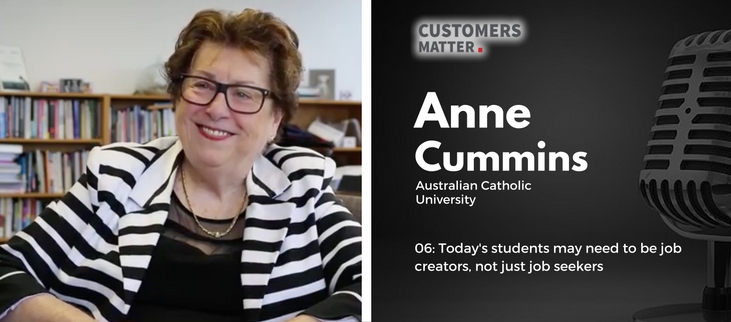
Komosion continues its work with the University sector and is delighted to have interviewed Professor Anne Cummins, Deputy Vice Chancellor, Australian Catholic University, who is reshaping Teaching and Learning in response to the voice of the student.
Among many startling observations in this interview, she explains what is changing and why, after University, students may need to create their own jobs – not just seek them.
Having worked with Universities in the past and present on projects such as student journey mapping, Komosion’s first project was with ACU some years ago, whereby we helped ACU discover that its current way of communicating to students wasn’t working, and what we could implement to better engage students.
After completely revising all of its communications strategies, ACU now attunes its students to opportunities by its new digital channels of engagement, such as new online student portals. ACU’s new digital strategy aims to be continuously connected to its students, delivering relevant, important and timely information to them. As a result, ACU’s entrepreneurial approach is aligning with students, anticipating their needs and dismantling barriers like never before.
John: Few sectors have as much influence in our lives and the direction our lives might take as education and there seems to be a fairly new and urgent conversation taking place in the agenda setting government departments, the boardrooms and corridors of business that education more than ever before is vital to the economy of the future and especially to the new jobs in the ever expanding digital and share economies. It’s going to be vital to maintaining standards of living that we Australians have long taken for granted. I’m very excited to be here with Professor Anne Cummins, the deputy vice chancellor of students learning and teaching at the Australian Catholic University. And Anne is going to share her thoughts and insights into the rapidly evolving education landscape. We’re sitting here in magnificent North Sydney and Anne welcome to Komosion’s customers matter podcast series.
Anne: Thanks John.
John: Anne I’d like to start just by understanding a little bit about your own background, where you grew up and where you were educated by way of setting the scene for how you’ve come to be in such an influential and important role today?
Anne: Well I grew up in Sydney and I’ve spend the better part of my life in Sydney, several years in Canberra as well but I was educated by the Ursuline Sisters who are a European order and had a very strong commitment to the education of girls in a holistic way so both academically, spiritually and culturally and I think that was a very good basis for me. My first degree was in education from what was then the Canberra College of Advanced Education and later on my studies were at Macquarie University and Boston College in the United States. I started my career as a primary school teacher, quickly found that you need to be much more skilled and creative than I was to be a successful primary school teacher so I moved to secondary where my skills I think were a better fit. And I went through that process becoming eventually a principal of a large school and then working up the systems level in a set of 54 schools. And then worked for myself as a consultant for ten years advising government welfare agencies, not for profits and educational institutions on leadership and strategy. And then accidently came to Australian Catholic University, it was an organisation I knew, I’d sat on their senate for a number of years but I came when they were having a transition between one vice chancellor and the next and I was here just to fill a gap. And then applied for what was the newly created position, the deputy vice chancellor students learning and teaching and that finds me here.
John: Wow. So really education’s been at the heart of your career but also clearly you had the benefit of being empowered as a young woman and, you know, being able to really, you know, forge your way in a world that I guess back in the day may not have been as career orientated for a lot of women as, you know, wouldn’t have presented the opportunities that you’ve obviously managed to achieve as a matter of course?
Anne: I think I was very fortunate. Only about a quarter of my cohort went from year 10 to year 11 in those days so to actually get to matriculation was quite significant for girls at that time, I was fortunate I had a family that supported my education. But I didn’t go straight to university, I went to work, my first employer was Dun and Bradstreet, the mercantile agents. And there I found out that there was some jobs I would be allowed to do in their organisation and some that I wouldn’t and at seventeen I was outraged by that and left and then joined a private company that went into publishing and so that was a good transition. But I did feel very much that I wanted to be a teacher so I chose to go to university and to study teaching.
John: So you find yourself here at the Australian Catholic University, could you tell me and more importantly I guess for the audience, for customers matter, about the scale, the breadth of the offering and where ACU students come from because it really is perhaps much larger and more substantial and global in its orientation than people may realise?
Anne: Mm. We’re a university of 32 thousand students, about twelve percent of those students are international and they come from about eighty different countries around the world, many of them from poorer countries like Nepal and Vietnam and the Philippines. We have students in age groups from school leavers at eighteen, nineteen to very senior citizens so our age profile is quite spread. Seventy percent of our students roughly are female because our disciplines are geared toward the industries where we have quite strong female participation, health, sciences and teaching. So we are a vocational university, we have seven campuses in Australia and we have a centre in Rome and many international partnerships. We have eleven research institutes. Our mission is really to work for the dignity of the human person and to serve the common good of society. And so all of our courses whether it be our law school or whether it be speech pathology or early childhood teaching are geared to be developing graduates who are distinctive in their concern for people and in their desire to be of service and to build a just and a rich community.
John: So really you’re educating people for purpose rather than profit?
Anne: Absolutely, absolutely. While we’re keen for our students to have an entrepreneurial spirit and to have a real sense of their personal worth and their contribution we also want them to be doing something that we think as part of our mission is very fulfilling and that’s actually to be adding to the benefit of society.
John: Now Anne tell me a bit about your role, you mentioned that it was a newly created role when you came into it, what does it involve and why was it created?
Anne: My role when it was initiated in 2009 it was quite different from the rest of the sector, other universities have come to similar roles since so I think that Professor Craven our vice chancellor at that time was quite perceptive in that he wanted to have a portfolio within the university that supported the academic portfolio run by the provost but that heard the student voice and injected the student voice back into the learning and teaching of the university. And so in my portfolio I have the learning and teaching centre which is an academic development unit for the academic staff of the university, it’s a policy support unit for academic board, it runs the e-learning capacity of the university and it actually works on scholarship of learning and teaching. So it’s a thought leader about quality curriculum, quality learning and teaching, assessment, evaluation.
John: So I think it’s an extremely interesting proposition that the students have a voice in the way learning is delivered and I’d really like to understand a little bit more about how you get inside the sort of minds and hearts of the students and translate those needs. I mean we hear a lot about students as customers these days, of course I’m assuming universities see them more broadly than that but could you explain a little bit how you’ve gone about grappling with that part of your mission?
Anne: One of the things about ACU and ACU the university is twenty five years old but it rests on a hundred and seventy five years of tradition of training teachers and nurses and it’s always been a very student focussed institution and so in our DNA is a very strong partnership between our academic staff and our students and a really strong sense of collegiality. So feedback is a normal part of that but when you get to thirty two thousand students you have to actually have some systems for that as well. So every unit of study that a student undertakes has a short questionnaire at the end of it which allows the student to reflect on the quality of the teaching, the quality of their learning experience and to give us some free feedback as well about how things are going for them. Now we call that SELT and that’s built in to a lot of things at the university, it’s built into our course evaluations and renewals, it’s built into individual academics promotion structures, it’s built into our planning frameworks. So a lot of work is done to look at that data and to feed back to our students what the outcomes of their feedback to us is so we close the loop. Now we’re getting fifty two percent of our students who fill in that voluntary questionnaire at the end of each unit, that’s an amazing return rate and I think that’s because students do know that if something goes in the next time that they’re in that school or around the university they’ll see that a change has been made.
John: Now the way in which Komosion came to know the Australian Catholic University some years ago you recognised a communications challenge I think when there were only a handful of applicants for a very generous opportunity from memory to study for a week in New York, expenses paid, accommodation provided and it was open to hundreds. So what did ACU and your portfolio in particular do to reorient the way it engaged with students as a consequence of, why was that an important moment and what did it mean?
Anne: Well it was important for two reasons, it showed me that I was sending out a newsletter and no one was reading it and that was pretty dramatic but it also showed me that students were not attuned to opportunity and that we needed to get them to be attuned to opportunity. And so what the outcome of that has been is that we’ve had a complete revision of our communication strategies, the university’s undergoing a major digital strategy at the moment so our communication strategies are part of that, we’re building a new student portal, we’re working with students to talk about the communication channels that are best for them for particular things. Students are connected all the time but they’re not always really in communication with us and they feel that they’re over surveyed, they feel that they get too much information they don’t want, they feel that it’s hard to sift through what’s important and what’s not, they know that I’m sneaky enough to put something in the middle of the newsletter and they may miss out if they don’t read it. So I do that from time to time, every couple of months I’ll sneak in a hundred movie passes and just see how quickly that they’re picking them up. But we’re getting to have a deeper sharing of what they want and we’re beginning to personalise our communication tools to that so they can drive what they’re hearing from us.
John: I mean in my world we would say that that means you’ve come to understand if you like the student journey and you’re looking to maybe better align with and anticipate the ways in which students might expect to be communicated with?
Anne: We’re definitely doing that, we’re definitely looking at students before they come, as they’re entering in the university and we’re taking out the barriers. We found that some of our online enrolment processes were very complex, we’re streamlining some of their access to tutorials and things like that and then we’re provoking them with information just in time for the things that they might need. So now is exam time we’re about to tell them about last minute exam preparation, we will alert them to what’s available over the summer vacation shortly, things like that.
John: As someone said to me once it’s almost you’re handing the cold glass of water just before someone realised they were thirsty?
Anne: Yes trying to.
John: So that’s the way in which the digital economy in some respects is impacting on new ways that you need to communicate with your students but could you also tell me a bit about what has the digital economy meant for the process of teaching and learning and how is that changing practices?
Anne: Mm. I think the fact that students expect to have access to the university through their phone basically wherever they are, whatever time, it has quite a number of very positive impacts like our library service is highly accessible, once upon a time you needed to be in the library and I would say our libraries are still crowded with students because they’re nice places to be and it’s a social milieu but they can access the same kind of help digitally now as they would have had to go to the library for before, they do even very simple things like the books they want to take out and pick them up when they come on campus. So that kind of change is quite radical. The electronic classroom, what we call LEO, our learning environment online, is much, much more important to students now, everything filters through it, assignments are uplifted onto it, marked on it, returned to them on it so that those transactions that used to be quite cumbersome, you know you had to get on a train and come here by five o’clock to have put your assignment in the box outside the lecturers door, those things are of the past. We’re very much in the digital space for all of those transactions now. The other thing that’s happening is of course you’ve got access to much, much richer and varied information and content material and simulations. And you can do things that you might have had to do in a lab or you might have had to do in a placement external to the university and you can do them through simulations in a way that we’ve never had access to that before so that’s a really big change to the curriculum. The other thing is that students can be more self-directed in how they use the curriculum and this is actually quite a challenge to the traditional model of the course, the unit and the student pacing themselves at the pace we present. They can now access materials that might be in a unit that they’re not doing or they might only want to do part of a unit so that process of unbundling what’s been a fairly tight course structure. So we’re having to look for new ways to develop our courses and we have a project on the go at the moment in the MBA programme to actually badge components of the MBA so that you get a certification for having achieved things and it may well add up to your MBA in time but you don’t have to do the MBA along the track that we prescribe in the first instance.
John: Does that suggest you could even do your degree more quickly than perhaps previously you would have been able to do it, is it you can do it around work, is it a l-?
Anne: Absolutely, absolutely, it’s more flexible and it fits more with what people are doing in their lives. And you know while there are some things about, and a lot of our students would like to do a lot of their degrees more quickly and there are some benefits in that, I actually am quite a proponent of acceleration, you also do need some time to digest, reflect on and integrate learning. And so it’s not just about stepping through and doing the assessments and then getting the unit under your belt, it’s actually about walking the journey of having an education. And so there is a balancing act that we’d like to advise students around that.
John: What about the actual experience in the classroom, I remember, you know, sitting with Leonie Kramer when she was teaching grammar and it was turgid process of, you know, being lectured from the front of the room around ??, I think it damaged me for life [laugh]. That being said it was valuable nonetheless but the process itself was excruciatingly painful. What has the digital economy meant for the classroom experience and how it’s changed?
Anne: I think it’s done two things, I think it’s raised students expectations that what happens in their classrooms will be more engaging and sometimes even more entertaining than they would have expected before. So I think the distance between that kind of traditional lecture experience and what we would call infotainment or, you know, a kind of documentary experience where we’re fully engaged in something and we’re learning but we’re enjoying, I think the classroom’s come into that space. And they’re expecting to be more interactive, they’re expecting to have more say themselves in the process and they are expecting to see different resources used. And the biggest critique we get is that our technology’s not used extensively enough and the people who use it don’t use it well enough. So upskilling our academic staff in regard to that is a major project.
John: Politicians have made innovation a centrepiece of the future of the Australian economy and I’m curious to understand your view as to what this might mean for education especially in the university sector and how innovation driven here might benefit the broader economy from your perspective?
Anne: It’s interesting for a university like this where most of our degrees lead to professional accreditation that you need to practice as a something, to practice as an occupational therapist or to practice as a lawyer or to practice as a nurse you need a professional accreditation and so we’re very constrained in some ways by those accreditation authorities who say that the students have to have all of these kind of competencies. Innovation requires a bit of free space for people to experiment and to do different things so there’s a tension in getting through a programme and getting people to accreditation and developing within them an innovative and an entrepreneurial spirit which we think we have to do and we work with the tension but it’s probably harder to do in some spaces than others. That said those very professions need to have people who are innovators, they are facing all the disruptive changes that are out there in society generally so they need to have people who can innovate, who can think differently and the tension for us is to provide students with an education that gets them past the first barrier, professional accreditation but also gives them the skills to build a career in a rapidly changing environment.
John: So how do you do that?
Anne: Well I think partly it’s about the pedagogies you choose, so we often choose a problem solving pedagogy, so problem based learning or we will choose to do designed thinking within a unit or we will choose to do collaborative processes and not just straight competency building and, you know, reporting. So we also choose to have a co curriculum that supports our curriculum and we’re quite deliberate about that, we have in our co curriculum experiences that students do that enhance their graduate attributes. For instance we’ve just had fifty or sixty students from the North Sydney campus who’ve been working with a group across universities in Sydney doing entrepreneurial skills in a programme called interchange and that’s a design thinking course where they set up little companies, they do their pitch and they see if they can get funding to get their little company off the ground. So we’ve got co-curricular activities going on, we have other things like we’re very big on assisting our students ‘cause we have many students who come to university less well prepared and perhaps needing a little bit more polish around presentation skills so we do a lot of work on public speaking and we have toastmasters on all our campuses for instance. We encourage our students who are going to be teachers to have some other literally string to their bow, to learn the guitar or to be doing something where they’re taking something else into the teaching profession, it could be sport, could be music, could be whatever but something that enriches their offer beside the academic programme.
John: It’s interesting you say that, I remember I worked on the Sydney organising committee for the Olympic Games and the first big stuff gathering I attended up at the Seymour Centre as we were growing the business, it became too big ultimately to bring everyone together in that one venue, a number of the executives were doing things like playing piano and performing as part of the monthly staff briefing and it was quite dynamic and exciting. Foreign students we talked about before, the university is really providing opportunities, equitable opportunities for people from countries like as you’ve mentioned Nepal and the Philippines and so forth that would be incredible and invaluable but how do you go about understanding their wants and needs and meeting the needs of these students who must have quite distinct and different requirements?
Anne: Mm. We invest quite heavily in our international office and in our student support services to make sure that those students have a good experience in Australia and that they get to know and become friends with domestic students. The reason we keep it at around twelve percent and the reason we spread it over so many different countries is because we’ve found in the past that if you have most of your students coming out of one country it’s convenient and it’s easy but the experience they have is poor, they come here and they’re in a kind of cohort of their own people and their English doesn’t develop and they don’t actually get an Australian experience. So we work on that, we work with our domestic students to make sure that they embrace those students and we encourage them to share stories and to be able to be of assistance to them. We also have international student clubs and things like that so that they’re able to get support from each other ‘cause we find the peer support is really strong.
John: Now you mentioned the campus in Rome and I guess that eludes to the fact that the university has a faith base and I’m interested to know in what way the faith base differentiates the way in which ACU operates and does it provide any sort of competitive advantage or in this day and age is it not particularly relevant?
Anne: Mm. It’s really interesting because Australia’s a very secular country and catholic universities although there are two, and if you count the University of Divinity three, are an oddity in our system and ACU is a public and a catholic university so increasingly odd but we stand in a tradition of catholic universities around the world, there are sixteen million students in catholic universities around the world. And so if you go to other countries we’re not odd at all, we’re just part of the landscape. And so the thing that differentiates universities that stand in a catholic intellectual tradition are the things that are core to our mission, they’re about the dignity of the human person and they’re about transformative education for the common good and a challenging cultural value set that permeates the educational experience.
John: Well certainly our staff love working with the people at the Australian Catholic University, students and teachers, and I know that the culture that you’ve engendered here has a lot to do with that so we actually have people fighting to work with ACU over a myriad of other clients. What do you see as the education and career sectors of the future and how do you see ACU coding for changes in the way we work over time?
Anne: Mm. We think about this a lot because our big offer for our students is that we provide a professional education where they move onto employment. And many of our students are first in family at university or they’re coming from not necessarily, we do have some low SES students but most of our students come from the middle band of society but often not extremely affluent families and so they’re very concerned that they will get a job at the end and in fact frequently concerned that they have a job all the way through their university studies. We think that education is more than getting a job first of all and we think that we’re preparing them for the careers that they’re going out into at the end of their degrees but we don’t want them to think that that will be the end of their choices around that.
[direction]
John: So in terms of the education and career sectors of the future, so you mentioned that you’re training people for more than a job, to contribute more holistically over time and you don’t see learning as something that’s done once?
Anne: Mm. I think it’s very important that students learn to learn and that they learn to love to learn and that they realise that they have a responsibility to keep learning. We’d be very disappointed in a graduate who though gee I’ve got my degree now I’ve made it, we think it’s an entry qualification to your life, it’s not the end of that. In terms of the jobs of the future I think that there are jobs that are emerging and the whole digital agenda is pushing a type of job that requires a certain type of skills and those skills to me seem to be focussed around communication and around many of the soft skills that we teach because we teach professions who work with people. So we’re very keen on those soft skills, the skills to be able to negotiate, to be able to facilitate, the skills to be able to persuade, influence, all of those things. So I think that there will be jobs that will be knowledge jobs and will be focused there. There certainly will be jobs that require deeper and more focussed science, maths, technology, I think that there’s work and in all of our professions that we have degrees for here that is relevant, you know, the stem agenda is highly relevant to them going forward whether they’re in the health sciences or whether they’re in law or whether they’re in business or whether they’re in education. So those jobs I think will keep coming but I think that there is a bit of a grey spot where we don’t know what those jobs will be like and even more than that we don’t know how those jobs will be cast, they won’t necessarily be cast institutionally in the employment frameworks that we currently have. And so I think that for our students they need to know that at least at some point in their life they might be depending on themselves to be a job creator not just a job seeker.
John: How very interesting. Thinking about that how do you think the student experience will be different in say ten years’ time?
Anne: Well I think that some of the trends that are happening now will continue, students will be increasingly wanting flexibility but they also want the campus experience and they want the collegial experience with students and with the faculty. I think they will continue to be increasingly internationalised and we see that already with most of our students now are looking for some kind of international experience whether it’s a curriculum experience but more often it’s an offshore experience. I think that the barrier between work and study will become less, I think they’ll be looking for programmes where they actually train in the workplace, we’re looking at educational delivery, we have clinical skills at all the major hospitals so if you’re doing one of our health sciences courses you may well be doing more of your time at the hospital than you’re doing here. Likewise we’re teaching education programmes inside schools. So I think that barrier between where you’re going to go and where you are now will become more permeable.
John: Finally thinking about the age of digital disruption, the age of disruption, the age of the customer all of these badges that this current age has what are your top three tips for universities not just to survive but to thrive in this age of disruption?
Anne: I think listen to the students is the top one because I think the students have an intuitive understanding of where the world is going and where their place in it will be and I think we have to sometimes put aside the assumptions that we carry from coming out of a different socialisation and watch what’s happening to them in their socialisation and let them help us understand that, that’s the first one. The second one is listen to the employers and the stakeholders who will be working with the students when they leave us because if the students are not a good fit for their expectations then they will have great difficulty getting there. And the third one is be brave and don’t let assumptions about the way things have always been done force you into not making the changes as you need to make them.
John: Professor Anne Cummins thank you very much.
Anne: Thanks John.