

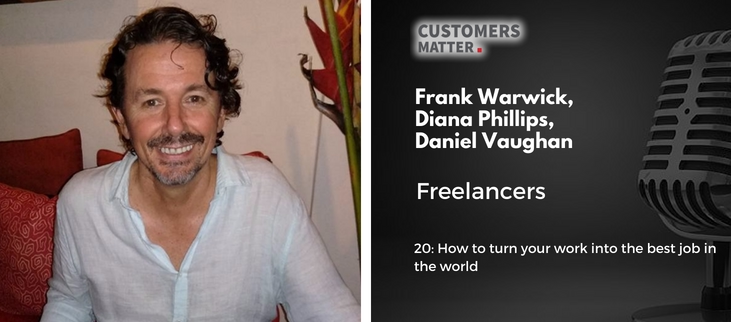
Would you like work from a tropical island, trading on your skills and doing the job you love? You’re not alone – only some people are doing it. Meet Diana, Frank and Daniel and welcome to their world – the new world of work…
John: So I’m sitting in Ubud in Bali and I’m here with Frank Warwick, Diana Phillips and Daniel Vaughan, and we’re going to talk today about the idea of distributed workforces. The fact that in this day and age really you can live and work anywhere in the world, but Bali and Ubud in particular is a place where many people actually flock to live and work remotely, and indeed recently Bali hosted the Running Remote Conference. So welcome to Customers Matter and I might start Diana with you. Tell me a little bit about your background and how you come to be living and working remotely from Bali?
Diana: Thank you. I’m pleased to be here John. Thank you. By background I am a graphic designer, art director, and grew into a creative director role. And so most of my experience is in the States but I’ve been working with multi-nationals in the States as well as in Europe and now here from Ubud. So we’ve done everything from you know hang tags for Adidas to global launches for Mazda, to everything in between. And it’s been really interesting the last few years how the industry has evolved to be able to do this kind of work, where the last project I did for Mazda I had a team of TGI artists in Stuttgart that were also working on Game of Thrones and they were creating backgrounds for the new Mazda launch using Miya wireframes. So we’d have a conference call with them and then we would work in Los Angeles and at the end of the day we’d conference with our client in Japan.
John: Amazing.
Diana: Truly.
John: And Daniel you’re also in the creative industry?
Daniel: I’m a digital artist. I started in the print industry working on chroma com systems. And as the MacIntosh Platform developed and became more powerful of course everybody switched over to that. So basically I’m a re-toucher and worked on accounts for various ad agencies, mostly car accounts.
John: And Frank you obviously do work with Komosion and I guess one of the things that people would be contemplating as they imagine working remotely is connectivity and what amazes me wandering around Bali is there doesn’t seem to be any lack of internet?
Frank: No it’s great internet here. The average place has a minimum of a 10MG connection. You can get a 100MG connection if you want. And it’s a lot of cheaper. It’s very reliable.
John: So what was your pathway to setting up in Bali? I mean we worked together probably almost a decade ago and you were sort of living the life on the Central Coast in New South Wales. How did you come to be here?
Frank: I guess you know I was just looking for a different life. I was getting a little bit burnt out. I wanted a change. And I’d come to Bali a lot. And it just seemed to be a progression for my wife and I to move here and see what became of it.
John: And Diana in your case you’re sort of working a little bit in California but spending a lot of time here now and is that the plan? Can you see the future of work being done this way?
Diana: I certainly hope so. I think it’s terribly exciting. Because you know it’s not only being able to work remotely but it’s also the benefit of being able to apply understanding of a different culture. The world is becoming smaller and smaller you know through all kinds of as you’ve mentioned connectivity and just the global presence of brands now. So to be able to offer our clients a little bit different perspective is also hugely valuable so you can structure a universal kind of language for international brands.
John: So how does that cultural difference inform the way you create?
Diana: You know it’s really interesting. When I worked in Europe a lot of the brands that I worked on were Unilever and the Unliver umbrella. So throughout Europe obviously languages are very very different. So our storytelling was basically a human kind of experience, and then the tagline would then be crafted for a particular audience. So in South East Asia there is a difference between Eastern cultures and Western cultures, and it’s a wonderful opportunity to be able to understand the differences and the similarities.
John: One of the things that strikes me having had a week up here is also there’s a real mindfulness and also a health and wellbeing culture that seems to be part of the lure if you like for a lot of Western expatriates?
Diana: Certainly there’s that. Also the thing that has struck me over and over is the connection to family here, and that permeates every aspect of society, whether it’s Hindu or Muslim or ah Buddhism, you know, and that’s also a powerful message when you’re building a brand, trying to build loyalty and an emotional connection. And I love that.
John: And do you find Ubud itself is particularly unique and how would you describe the sort of environment of this particular part of Bali?
Diana: It’s a wonderful crossroads, because you do have the history of Ubud. It’s kind of an evolution of an old Kawi word ubat, which means medicine. So there’s been a healing kind of psychology here for ever, for a long long time, and that’s transmuted into wellness, health, yoga, all of that kind of thing. But it’s also supplemented by this incredible artistic community. If you go down any artery that leads to Ubud there’s a community that makes gold jewellery or silver jewellery or does wood carving or blows glass or creates textiles. It’s just a society that is rich rich rich in all kinds of craftsmanship.
John: And Daniel and Frank obviously the cost of living is pretty forgiving compared with major cities in the West. Can you live here affordably?
Daniel: Absolutely you can. I mean I was just back from Los Angeles where I sort of had sticker shock and so it’s nice to come back here. It’s also nice that we pretty much roll out of bed and log in and we’re working. We’re also fifteen hours ahead so I have people I work with in Los Angeles and at the end of their day they can give me what they haven’t finished and when they wake up in the morning and it’s waiting for them.
Frank: Yeah. Yet working in Sydney they’re two hours ahead so an eight AM meeting is very hard. [laugh]
Daniel: So you have to work faster Frank.
John: And in terms of physical connection to Asia do you find that living here you travel or you’re really in a cocoon where you don’t need to be anywhere else?
Daniel: Well you can travel and it’s a good springboard to the rest of Asia. It’s not far to go to India, Thailand, Singapore. It’s pretty easy. It doesn’t takes long. It’s inexpensive. But there’s just so many places on the island and all the islands all around us.
John: And Diana I was interested you mentioned this idea of really curating a service. And I think from what I’ve seen people are curating local skilled people but also across Asia often.
Diana: That’s one of the things that we’re really interested in because there is so much talent here. And a lot of our clients have in the past outsourced to let’s say the Philippines. The problem became getting work back that was not up to a certain level. So part of what we intend and are working really hard to do is curate the work so that we’re almost like the stop gap. So if work comes to us we don’t pass it along until it’s perfect. And that’s a service that we really really believe in.
John: I mean certainly in my experience where I’ve sought to outsource and we’ve used people in Vietnam and we’ve used India and we’ve used the Ukraine the big challenge is getting not stuff made to order but stuff where people are solving problems for you not just going through the motions of doing what they’re told.
Diana: . . . Or creating another problem.
John: Yeah, well precisely yeah.
Diana: Right, yeah.
John: So that still seems to be one of the challenges and it sounds like you’re seeing an opportunity to help meet that challenge?
Diana: Absolutely. Because of my background and trying to come up with a consistent language for international brands that works from country to country to country, it’s hugely important that that tone of voice is the same and that you know everything that makes a brand unique is impeccably executed each time.
John: And what about the diversity of skills. So what’s the spread of expertise that you can connect with from Ubud and within Indonesia and I guess within the region more generally? What sort of spectrum of talent are we talking about?
Diana: Well for me being an art director, creative background, I’m completely impressed with the level of for instance typography, for any kind of graphic arts. There’s also an international community in Ubud because of the draw to Ubud itself that is somewhat transitory but there’s always an influx of people that are programmers, copy writers, designers that-
Daniel: . . . A lot of creativity.
Diana: That are international not just from South East Asia. But South East Asia itself is just a huge huge rich culture of creativity.
John: I mean I think it’s interesting despite in my case Australia’s proximity to Asia I guess in the case of California being that much further away a lot of people just don’t understand the scale of the population here. The age, it’s youthful. I mean Indonesia itself is what two hundred million plus people.
Frank: . . . Two hundred and eighty-five million.
John: Two hundred and eighty-five million.
Frank: Yeah where 70 per cent of the population is under 40.
John: It’s amazing.
Frank: Yeah. And it’s only one of three countries in the world that it is like this. So in the next ten years this switched on population is going to be running the country. Where in the West we have the majority of people are retiring, the baby boomers and the next generation. Here the big population is in their thirties, and they’re the ones that are going to be leading the country in the future.
John: So Daniel from your point of view what do you see as the landscape unfolding over the next decade here? Frank is obviously seeing the youth coming through which is going to be huge.
Daniel: Well I think Frank’s right. I think the population’s changing really rapidly. They’re all getting educated. And they all have computers and as you said earlier in their cell phones they have a computer now. So the technology is just going I think it’s going to reshape the map. I mean the geography doesn’t matter so much anymore.
Frank: Yeah you see a lot of guys who are just labourers working for the minimum wage in Indonesia and they all have a smart phone and they’re all chatting back to their family wherever they come from. It’s just everybody does it.
Diana: . . . And if I could also interject here. I also see an opportunity for women particularly in Indonesia that are becoming, have more opportunity for education, that are looking for maybe a little bit less traditional or not necessarily giving up their traditional roles but expanding the role of a woman in a household. And I find that really exciting.
John: And Diana you also were speaking a little earlier about the affordability, the cost of doing business, and that’s a competitive advantage I presume. What sort of differential do you think can be delivered by you know sourcing your team from a place like a Ubud?
Diana: You know part of what we’ve found is that we’re able to source by project because of the amount of talent here. So that’s a huge impact. Then also because the cost of living here is so much less, I could basically find someone as talented as I could in Los Angeles, but because the cost of living, because of the opportunity that I’m presenting to someone, it’s going to be invaluable to a person in Bali. Whereas in Los Angeles it might be just another job. So that also factors into enthusiasm, the education part of it, the loyalty part of it, and just being able to give back to the culture that we’re taking part of.
John: I mean if we flip it around as well it’s got profound implications for workforces back in a place like LA or in Sydney as well?
Diana: Indeed. Indeed.
John: . . . What do you think the implications are for people in those marketplaces?
Diana: Well you know we’re going to have to wait and see. I hope that people wake up and you know kind of like understand that the world is becoming smaller and that you can never take anything for granted, because there is a talent pool here is that is as diverse and rich as a lot of the talent that I find in the US or Europe.
John: Diana, you and Daniel have also set up a little business here. Can you tell me a bit about that and what you’ve gone about doing, and what you’re learning really through creating a business, a start-up?
Diana: Well, it’s really such a random thing; it’s totally random. When we moved here, we had no idea to do what we are doing at the moment. But as we came to know Ubud a little bit, we found gelato shops ad nauseum. And we kept thinking, gosh, isn’t there a healthier alternative, because of all the yoga people, because of all the vegans here? So, we were redoing our little house in California before we moved and it was hotter than heck in August-
Daniel: 110-degree Paso Robles weather.
Diana: So, about three o’clock every afternoon, we would stop and have a popsicle and just try and cool down for a second. And when we arrived here, it was right before rainy season, so it was again hot and humid. And we’re like, where’s a popsicle? We need a popsicle! So, that’s how we came up with Balipop. And the idea was to take all this beautiful, natural fruit and do something as an alternative to gelato. And so, we worked on recipes and came up with this. And I think we’re getting to the point where it’s a viable idea. But, we also realised that it wasn’t just enough to do a tasty, healthy product. We also, because of the nature of the pollution problem in Bali, plastic is everywhere-
Daniel: In the world!
Diana: Yes.
Daniel: I mean I’m a scuba-diver and I haven’t gone anywhere where I haven’t had a dive where I came across a big chunk of plastic going by during the middle of my diver. Outer islands here, I mean in the middle of nowhere, John, and there goes the plastic!
Diana: Right. So, part of what we wanted to take on as a social responsibility to the island, to the people, because we are guests on the island basically, was to try and come up with a solution that would limit the amount of plastic that we are putting back into the world. So, we actually package our pops with a banana leaf. So, if somebody drops it on the street, it’s biodegradable, which is very limiting to the amount of expansion that we can do, because banana leaves are not exactly the most durable substance on earth! So, we’re constantly looking for alternatives for a compostable packaging product. And that’s part of our mission is to pursue that.
John: Fantastic. Thank you.
Diana: Thank you very much.
Daniel: Thank you