

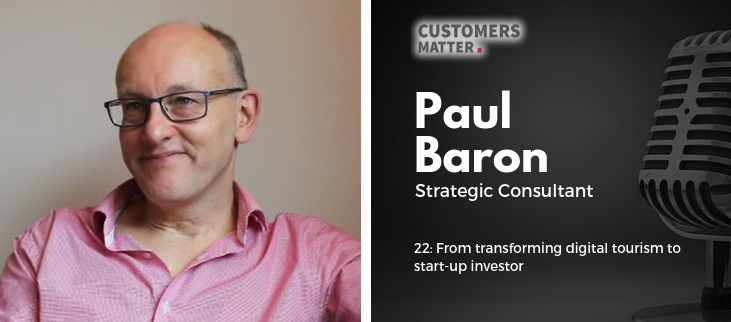
John: So today I’m in Melbourne and I’m joined by Paul Baron who is a Digital Advisor, Consultant and Strategist. Paul has considerable leadership experience in technology, digital marketing, social media and content areas, particularly in Government consumer marketing in a tourism context. In fact I’ve known Paul for well over a decade. And for fifteen years he basically was the man who ran Visit Victoria’s digital presence and grew it as the times rapidly changed. He’s also the President of the Australian Chapter of the International Federation of IT Travel and Tourism, and has recently become a member of Melbourne Angels Investor Group which works with a range of a start-ups in both the travel and digital technology spaces. So today we’re going to have a really interesting conversation I think and hear really about Paul’s life and most importantly what he sees happening in this world of somewhat profound digital disruption. Paul welcome to Customers Matter.
Paul: Thank you. Thanks John.
John: So you began your career by studying IT and people will identify a subtle Kiwi lilt I think. Tell us a little bit about your career path and how you chose the path you chose and some of the twists and turns on the way.
Paul: Well John I did study in New Zealand in Otago. And when I graduated, which actually I have a degree in economics, but I did do some computer science in my degree, and I came to Melbourne seeking my fortune. I figured if I failed I could always sneak back home and just pretend that I’d been overseas on a holiday. So I came out here with a suitcase. And my Dad lent me some money to buy a suit and my first job with a consulting company, a small one, doing a lot of regional consulting. Half my job happened to be looking after the company computers. Now this was back in 1988 so pretty early. And doing some business plans for biotech companies and things like that but also doing a lot of computer system stuff. And then probably my big break was going to work for BP where they were looking for someone who spanned the gap between business and technology and I suppose that’s been the sweet spot in my career.
John: So economics. So did you graduate as an economist in effect?
Paul: Yeah that’s right. But funnily enough it was BP who invested in technology, my technology skills, because they wanted people at that time who could make that bridge. And so they sent me on all sorts of programming courses and I in fact worked on a C Plus Infomix and DDSQL system in UK for six months.
John: Right so you were a code monkey?
Paul: I was a coder for a while. And look it was fascinating and I really am very thankful for the time with BP. Another thing I guess, I was working at that time in the retail part of BP, and so we were rolling out forecourt systems and back offices systems for what was then Food Plus and is now BP Express. And they are franchise systems where you’re go in and it’s business in a box you just run the shop and all you’re ordering systems, everything’s there for your reporting systems, and it was those systems there that I was working on with a great bunch of people.
John: So interesting because of course nowadays point of sale tying back into your CRM systems and so forth it’s all core to the single customer view really.
Paul: It is. Now interestingly enough in those days we had a bank of modems that rang the service stations overnight and pulled back the sales data, and so we could start to do analysis on people who bought milk with petrol. And in those early days also we were thinking about shop layouts. And all of that data was sucked in to do that.
John: So this was sort of really trying to predictively model what people might buy and how to shape the layout of the store to make it more alluring for them to add to their purchase?
Paul: Exactly right. But anyway all good things come to an end. I felt after five or so years with them I wanted to go exploring and I went off to Italy and did a bit of sculpture in fact in Florence. My then girlfriend was there as well so we had a bit of adventure and it was good fun. But as often happens we broke up. That’s a funny story really. But anyway I ended up working in London for a bit. And then I came across an idea for a start-up and it’s a little bit too early for a start-up. It was ’94. And that was an online space for IT contractors and professionals, if you like job bulletin board driven by content and stories for people who wanted to work in IT contracting. So I had my own first web start-up after that point.
John: Super interesting. It was probably just as someone was starting to think about Monster in America and some of these job boards Seek even.
Paul: That’s right.
John: But as you say ’94, well the browser was probably still at Netscape.
Paul: It was pretty ordinary. And you were still debating about how much graphics if any you should use on your site because it slows it down so much.
John: So what happened with that little venture?
Paul: Well I’ve got to say I think of it like an MBA. It costs me about as much money and took me about as much time and of course in those days really hard to commercialise models. In those days a lot of recruitment companies would advertise in The Australian, that was the newspaper. They’d spend an arm and leg and that was where you advertised. But I went around to try and sell advertising in the space and they said oh we’re doing our own thing with websites we’re not looking to advertise online. Very very hard to monetise. Got a couple of people who were prepared to sponsor the environment but this is before even listings of the real estate. If you think about how well that’s done now.
John: So you finished your virtual MBA by actually running out of petrol presumably and saying I need a real job, is that what happened or?
Paul: Well that’s exactly right. But the great thing is it sort of set me up really with a bunch of digital skills at the beginning of really when a lot of companies and organisations were developing their web presences early on. And I got sucked a little bit into Government.
John: So how did that happen and where did you find yourself on your feet and what happened from there?
Paul: Look I guess I had some good friends at a company called SMS Consulting in those days which ultimately turned into things like Sausage and then Sausage disappeared. So I could see a lot of changes there.
John: Was it acquired ultimately by Melbourne IT? I remember SMS Consulting but yeah.
Paul: Yeah but look they were bought by Sausage but then someone else bought them.
John: They were quite a big IT integrator at one stage I think.
Paul: I mean they still exist I think.
John: Yeah.
Paul: I should be knowledge about this. Funnily enough a lot of the alumni have gone off and done other things and run consulting companies. I mean SMS in the ‘90’s I think had a famously good culture. I mean they were pretty much a kind of group that if you needed bright people to come and help you, and they were doing a lot of work with Telstra, that’s where I first started doing some work with them, they would give you best and brightest, and they’d often embed themselves in the team for awhile to do big changes.
John: So what was your role there and how did that lead to the next chapter in your career?
Paul: In terms of digital it was actually doing some work for Planning and Heritage, and doing all their early websites online. One of the things I did was the online directory, if you wanted to look up the planning schemes and things like that. So early planning. At that point Victoria was digitalising the State Digital Map Base. So there was a lot of activity in that space. My focus was more on the consumer facing websites.
John: And what year are we talking about now, early 2000’s?
Paul: It was probably ’96, ’97, ’98. About that time.
John: Oh wow. Okay yeah so Victoria was out of the blocks early.
Paul: Yeah.
John: And the Lands Departments with the maps, the geo spatial mapping.
Paul: Yes. And there was also Heritage so you had a lot of heritage data. And in those times you had internal systems that were just starting to speak to external systems. So in those days there was a lot of Lotus Notes around, and so there was a lot of sort of plugging in Lotus Notes database surprisingly and squirting that data into the world, and often it was the ability to look up databases.
John: And were you overseeing the technical solution or what exactly was the nature of your role?
Paul: Well in the early days I was executing stuff. But then what happened is, and particularly through those sort of probably ’96 to ’99, you saw the evolution of a lot of companies delivering web stuff and you probably saw that too John that suddenly you saw the emergence of people providing those services because there was growing demand. So what happened for me is I started off coming and building websites. But then I started pretty much managing the procurement of digital agencies doing much larger projects.
John: As an insourced resource from SMS to Government?
Paul: That’s right. So I was sort of an expert in sort of dealing as a consultant to look after the digital, not only the strategies but the execution of projects through other people, which actually led onto my first piece of work with Tourism Victoria role.
John: So when and how did you sort of become involved and ultimately really the head of digital for Visit Victoria, and that was a gig I think that ran for about fifteen years?
Paul: Yes. Well my first introduction really, Tourism Victoria, under Jeff Floyd, was lucky enough, well I wouldn’t say lucky, they worked very hard to land about a seven point two million dollar budget or a programme to make Victoria digital in a tourism sense.
John: And when was this?
Paul: That was ’99. So September ’99 I started. I knew the then Project Director through SMS. I’d joined them independently of that. And he said mate you know about the dual agencies and you know about procurement and you know about running sort of websites we need you to come and help us with this large project. And it was always going to be outsourced.
John: So I think back in that time was probably when the tourism marketing campaign that put Victoria in many respects at the forefront of tourism engagement was about to roll out and that would be the Jigsaw campaign am I right in thinking about that?
Paul: That’s right. It’s a little earlier. So the Jigsaw campaign, the thinking behind the Jigsaw campaign, and in terms of Tourism Victoria’s evolution, was really more the mid-Nineties. And because a lot of the early thinking happened there, prior to my arrival, this is around the Roy Morgan Value Segments, where they were focussing on people what we would describe these days as creative opinion leaders. They were particularly under people like Don Richter, Durana Wern, people of that nature, and of course that was the Bob Annells time. There was a range of things they had to do. Rationalising the regions was one part of that component. But also I guess positioning Melbourne. Look the thing they did that was really good, it’s not very obvious, is they were very data driven. So they started measuring a lot of branded tributes and they realised that no city in Australia owned things like romance. Few of them were outstanding in terms of food and wine, arts and culture. And what the plan was to say well let’s focus on brand because if we can position Melbourne and Victoria as a premium destination in people’s minds we can attract the premium market because what we care about is not visitor numbers but spend. So the plan was to attract high spending visitors with the hope that they would actually spend a lot of money and have a significant impact, and they’d do that by associating the brand of Victoria as a premium brand with people for instance, and the target was often say professional women aged between about fifty and sixty in typically Sydney and places like that who guess what they love, food and wine, arts, culture, things of that nature, and you position Melbourne in that case it was the black and white romantic Melbourne ads as a romantic destination for instance, you feature the arts and culture, this premium destination, shopping of course is part of that, position that in their minds and try and own that. So that’s what the campaign tried to do. But more important they measured the impact of that campaign. And during the period of probably about ’97 to 2007 you could follow graphs of how they owned those branded tributes compared to competitors.
John: So what I find interesting about this is obviously it was a battle for hearts and minds, and as you said it was data driven from the get go.
Paul: Yeah. Absolutely yeah.
John: So what was the digital dimension to this and how did the digital platform play a role if you like and how did that evolve over time, over the fifteen years I guess?
Paul: It’s a very good question. Look even in those days you started to, with that sum of money, the platforms, the CMS platforms, content management systems, look towards personalisation of experience. Hard to believe now. I mean often we’re still struggling with that. So this was a massive project, a massive sum of money, and the industry expectations were enormously high. There’s many examples of the platforms. In this case it was Alliare Spectra which is a cold fusion platform that we selected. But there was many examples of failed projects of this scale at that time. It was a long and tortuous process. So it was an eighteenth month project pretty much. We did launch it. It all went well. But there’s certain things that were very complicated. So there was a bunch a new innovations at that time. This was prior to ATDW, the Australian Tourism Data Warehouse, which we might on touch on later. But essentially we were the first State to have a situation where operators would, let’s talk for a moment about the operator end rather than consumer end, if you were a hotel you’d log onto our system, create yourself a listing, upload photos, put yourself on a map, pay with a credit card and then appear on our website.
John: Because there was no Airbnb. There was no Stayz back then. So this was really Government marketplace making using digital platforms.
Paul: That’s right. If you think about it back in those days, back in 2001, very early local accommodation booking companies were one or two people. I’m thinking about the early starters. There was a lot of overseas sort of people but not much locally. And we tried to partner with those.
John: So there was a recognition at Tourism Victoria as it then was that not only was there a job to do to place Melbourne in the hearts and minds of affluent consumers, but in order for the digital platform to work you needed to enable the operators who had the offering to connect with that aspiration online. So you guys were really as I say creating a marketplace using digital tools and technologies.
Paul: I think you’re spot on. I think it’s wrong to think of the whole project as a seven million dollar spend on a website, far from it. The website was one component. Populating with product was one component. But a significant component was to try and raise the digital literacy of the industry. And in Victoria particularly we had in regional areas a lot of very small businesses without much of a digital footprint.
John: I mean a lot of people don’t appreciate that the profile of the tourism industry is almost the inverse of any other industry where instead of being ninety percent dominated by large business and ten percent SME’s, it’s ninety plus percent SME’s and a handful of very large businesses.
Paul: Yes right.
John: So there’s a lot more market failure I think in the sense that they don’t have the aggregative back office systems that allow historically anyway for the sort of initiatives that you’re describing. So that’s probably why the Government got involved.
Paul: And I mean look subsequent to that, if we talk about the needs of small business, later on in probably 2009 to 2013 we were still working on trying to raise the level of literacy in small business in the digital area. Because it’s multi-faceted, not only with booking systems and your own websites, but social media and all of those sort of things and it is core to marketing. In fact recently I was involved in a case study for Tourism Ireland who are struggling with that. And I suspect if you talk to regional tourism bodies today they’ll be still talking about how they can raise the level of digital literacy of their products.
John: So what were some of the bigger shifts that you saw during your time, during that fifteen year period. So we’ve touched on the early days of creating if you like a digital marketplace to connect consumers and operators of tourism product. What else happened over that sweep of fifteen years and what are you perhaps proudest of in terms of the impact you were able to make with the digital assets that were harnessed in the name of promoting Melbourne and Victoria across Australia and around the world?
Paul: Look I mean for me there were many highlights. I mean I’ve got to say if you’re in the space where tourism and digital intersect that’s a huge amount of fun. I probably stayed there too long to be fair. But it’s very hard to leave because it’s so much fun. So in the early days particularly just after 2001-2 the focus for me was on traffic, because we had spent a lot of money and we wanted to do well, but I think and particularly in those years we did tremendously well in terms of audience share building up. I mean it was organic. It was making the optimisation of the website that was my focus very much.
John: So how big an audience did you manage to build?
Paul: Well I know you were in Sydney at the time John. We had the largest share of any audience of any State, and that was a matter of some pride to me, and around the executive team it was an ongoing joke when we met around the table of online once again beating records in terms of the number of visitors off the back of what we were doing. I mean it was interesting in those early days visitors weren’t driven so much by campaigns. Optimisation was critical. Certainly these days obviously they’re much more campaign driven and there’s a far bigger focus on pay than there was.
John: So just to touch on those trends. So basically you architected a strategy that had disproportionate digital eyeballs if you like in the early days through basically optimising Tourism Victoria’s website to be found through search.
Paul: That is true but more than that. We spent more than anyone else on content, because content drives traffic. So we had at least a team of four editors all the time with content. We passionately believed that content was a key, not only to a visitor experience, but also driving traffic. And the internet’s a great niche engine. And it’s easy to see tourists as a kind of a mass of people charging from one thing to the next. One thing the optimisation process showed us was that people went like this, they don’t enter on the whole homepage, they went bumph, across all of our broader content, people across the spectrum could be interested in a flower show in Ballarat or a vintage car issue or where can I stay with pets. There’s not one sort of space. So you can use content to drive a very broad range of traffic into your space.
John: Now of course a couple of very significant things happened on your watch. One was the invention of the iPhone.
Paul: Yes.
John: And the other of course was the rise of social platforms.
Paul: Yes.
John: So you’ve spent a considerable amount of money, you’ve built your digital presence that you own and operate, you’ve optimised through great content. What happened when social and mobile came along?
Paul: That’s a great question, because we I think, now the dates are a bit fuzzy for me, maybe 2006 2007 from a social perspective that’s when we started to see social making an impact. Now we had a campaign at that time where we used social media for the first time. Now people were pretty sensitive about it in those times. The CEO at the time was Greg Hywood. And we spent probably the best part of six months convincing people up the chain, above Greg, the Minister, that it is okay for us to get into social media.
John: And the fear was?
Paul: You can’t control social media and Government is used to controlling the agenda. Remember this was a long time ago. People are used to the idea of social media.
John: So at this stage we’re used to pushing our message, but we’re not used to having someone come back and engage with us.
Paul: That’s right.
John: Positively or indeed potentially negatively.
Paul: That’s right. And also we didn’t know, we knew we had to moderate stuff, we knew it was twenty-four-seven situation. The potential for people to post material, particularly if it was a campaign site if you like, to post material. If we were going to moderate it it needed to almost appear instantly, or would we, would we post moderate. People don’t like to give you content and then a few weeks later have it appear. The expect-
John: Instantaneous.
Paul: Right.
John: So how did you deal with this and what happened?
Paul: Well in that case there was a few things. We decided we didn’t necessarily have the resources to cope, we didn’t know how many posts that we were going to get, and so we actually externalised the moderation of the content. Greg personally briefed the moderators of the content. So we had an external company. He personally briefed them.
John: So this is Greg Hywood?
Paul: Yeah that’s right.
John: Who’s now Chief Executive of Fairfax, probably about to leave, but who’d been a working journalist at The Financial Review and many other publications.
Paul: That’s right.
John: So he knew content.
Paul: He did know content. So what you posted went up straight away, and then straight after the person could view the content and decide. The person was to remove content after it had been posted.
John: So there was a lot of heavy manual moderation and management, but surely that wasn’t going to be sustainable. So what happened between then and now as it related to social platforms and how did you end up reconciling how social platforms and Government tourism agencies might relate to each other, and then I’d like to also hear a little bit about mobile and what that’s meant.
Paul: Yeah look you could say that campaign gave us training wheels. We had two significant issues during that campaign. Two posts that we felt had to be taken down, because one of them made a reference to a suicide for instance. It was not intended to be a bad post but it was not something that we wanted in that space. It was artistically filtered out.
John: So you moderated. But as I say the explosion of social, I mean I can’t imagine you could possibly try and moderate all social channels in this day and age?
Paul: No. And I think it gave us training wheels to get confident. So shortly after that we appointed the first Social Media Manager that I’m aware of in the Victorian Government and the first Community Manager, and we had a focussed strategy around that that then got signed off right up to the Board level. So we had the framework in which to operate. And we also took everyone on the journey of you don’t have control. What was interesting in that time is that straight away social led into data. So our then Social Media Manager was tremendously strong with data. He was Phil Lees. He was a fantastic guy.
John: So what were you suddenly discovering, seeing, learning as it related to data?
Paul: Well particularly it was often an insights driven thing. When people posted for instance or engaged with us on social media we could figure out for instance they were in Sydney and then maybe we could figure out later when they posted when they’re in Melbourne, that hey they’ve engaged with the platform in Sydney and later on they actually visited Melbourne and posted something. The challenge we often had I think is we had a heck of a lot data. We had huge challenges turning data into insights into action. And I think that’s still a problem for marketers today. But the platforms are getting a hell of a lot better. Maybe we should jump to mobile too to answer that.
John: Yeah tell me.
Paul: We were always trying to innovate. We had a B ’n B guide which was written in WAP. I don’t know if you remember WAP. But it was a very simple HTML that you could use on phones. So our first experiment, which was about 2001-2, we did a WAP thing which was probably used by three people. The next thing we did we worked with Telstra on a platform. I think it was called i-mode, which is the Japanese version of mobile devices that were sort of popular at that time. Telstra brought it out here hoping that the Australians would adopt i-mode because this is all pre-iPhone stuff. And so we did an experiment there with them on that and of course about six people probably used it. And then the iPhone turned up. And straight away you knew things were changing and were about to change. However like many people early experiments with Apps generally weren’t that successful. With Apps well for us we found people weren’t inclined to download them and yes we promoted them strongly as a thing. We often used Apps as part of campaigns too as experimental things. But it wasn’t really until mobile web took off that the traffic we got from mobile visitation went through the roof.
John: And when was this, when did it really start to kick in?
Paul: Oh gees, probably 2010, I’m thinking. I can’t remember the date but I remember talking to Mike Howser who’s now the head of Digital at Visit Victoria. We were trying to guess when mobile was going to overtake sort of desktop, and it was creeping up there, and when was it going to get over fifty percent, and at that time, and you probably remember Google started talking about, and others, started talking about designing for mobile first. I mean that was over five years ago now. So we were starting to think about what mobile experiences looked like.
John: So the digital eco-system, tell me how does a business in this day reconcile social platforms, its own website, CRM, mobile, how do you make sense of all this if you’re trying to engage an audience?
Paul: Well these days if you’re in digital, even if you’re in marketing, let’s not say digital, you need a fantastically solid marketing technology infrastructure behind what you’re doing. Because you want to track somebody from the moment they first see a bit of your marketing through to the early engagement with you through to perhaps a purchase, post purchase, also then speaking about your product, what happens next, all of those things, and then an ongoing engagement. And I’m not just talking about people selling products, even talking about the Government in this instance, but I’ll come back to that in a moment. So particularly toward the end of my time with Tourism Victoria Visit Victoria a lot of the focus moved from an idea if you like of an email address driven kind of marketing programme where you’re building a profile around there, to be building a profile of someone around their social profiles, and in building pictures using what’s called a DMP, data management platforms, to build a picture of a customer that you might know nothing about apart from the fact that they’ve just engaged with your advertising or they’ve just visited your website. But the ability to marry up your advertising model with social profiles and enrich that with data from other sources available on that product will allow you to build up a fantastic picture of your customers. Now a lot of people feel a little uncomfortable with that, because if you’re starting to build profiles of customers is this going to be evil, is it going to be good.
John: But these are anonymous profiles that you’re describing or are you starting to be able to see who these people are?
Paul: Very much. Once you can connect them to a social profile, and in fact when you look at DMP’s and there’s a local company for instance Lexer which is sort of a DMP type product. Lexer’s DNA if you like is in social. They started off with a social listing platform for customers like Qantas, but then they realised I think that they could use the social profiles to integrate with advertising models and other data sources to build up profiles of customers that you might reasonably want to target.
John: So in effect through the combination of these technologies what we’re able to do is start to identify behaviours online that are relevant to our business, and then actually materialise that people are behaving that way and start to retarget and remarket to them. Is that essentially how it works?
Paul: That’s true. And it can also be applied in some recent work that I did with the Department of Economic Development. It can be applied to all sorts of different situations to optimise customer experience. Now for instance the Department of Economic Development, the business engagement part, they have a database of some thirty thousand businesses in Victoria. They probably actively engage with maybe five to ten thousand of those. And they use the Sales Force platform to do that. However they’re scratching the surface regarding its sort of business engagement because if they want to communicate to a bunch of different businesses often they’ll want to communicate to a segment or a wide range of businesses and while they’ve got access to the ABR, the Australian Business Register, people don’t want to hear from Government you actually have to pay to communicate to businesses really through advertising platforms. But of course that’s anonymous. So in some ways you’ve got to match up the anonymous part of advertising with the profiles of businesses you might have to then say well here’s an opportunity for instance to employ some new people or here’s some regulatory things we’ve got to tell. Well let’s do that in an advertising platform, let’s somehow plug that into yes I’ve told that segment or yes I’ve communicated to that segment that piece of information, or yes I’ve put an offer out maybe relating to an employment issue or policy issue, but have that plug into your data base so you know who you’re talking to and how they’ve responded. And with platforms like Sales Force if you can build up pictures of people you can integrate with their sort of DNP type programmes. And then you can have a situation where for the sake of argument somebody calls you up, you’re running Sales Force on your desktop, you pick up your phone, guess what you’re phone’s IP enabled, you see it’s Jim from Ford calling. It can pull up as you’re picking up the phone all the information about the engagements that Jim from Ford has had with the Department. You can figure out that Ford’s received a grant. You can see maybe that Jim’s seen some advertising on something. You can see every engagement if you like that Jim’s had or Ford’s had with that Department. Or maybe you can see somebody else has called from Ford recently. So straight away the customer service from a Government perspective is right there right in front of you. You get as a Government officer a picture of that relationship with that person and have a fair idea of what the needs might be. And more than that you integrate that with their communications. So where for instance you see what email usages they’ve got or you can see what articles they’ve read. So maybe some people might find that a bit invasive, and perhaps there is an argument it’s pretty invasive, well it allows the customer service to be fantastic and a much more strategic approach in dealing with customers.
John: So I think it’s fascinating. We started talking about though the small business operator. How on earth, with the complexity of what you’ve just described, do the small business players in this world manage to get their heads around this and leverage it. Are there ways that businesses can set up this kind of eco-system, have this relationship with the marketplace, without having to spend millions of dollars?
Paul: Yes. I think you tend to need help, because you’ve kind of got of architect out the experience. So there are products that in themselves are not that expensive. The expense is really in the strategic end. And I suppose it’s a little bit like the difference between doing your own tax and getting your accountant to do your tax. You as a small business if you’re capable can research out these products, start off with some CRM’s and then build up your own marketing technology platform and integrate your advertising. But it’s worth putting some money into the strategic end of building a platform. You don’t have to spend an arm and a leg on this stuff but you want a strategy in place. And the issue tends to be that they tend to move a lot. There tends to be technologies that are the flavour of month. You know for a while everybody jumping on the Adobe platform for instance. Now I’m not sure how small you need to be to justify being part of the Adobe platform. I think you need to be reasonably large. But there are other competitor platforms which are cheaper and even like Lexer is not excessively expensive to start to put your toe in the water and saying let’s talk about social engagement where we’re for the sake of argument if we’re primarily advertising on social platforms let’s build up a picture through a DNP like Lexer which will allow us to build on the social platform or at least connecting our marketing with our social platforms and then we maintain a relationship in a social sense with some of our customers. So I think it’s an area you have to put your toe in but I would seek advice on this space.
John: So Paul it’s been a fascinating journey. Just in wrapping up, tell us when did you finish up at Visit Victoria and what are you doing with yourself now and then obviously you are doing some consulting around this very topic we’ve been discussing but you’re also involved with Angel Investors as I said at the outset. So what’s life after fifteen years of being consumed with all things digital and tourism now for you?
Paul: Well like many people I suppose I’d felt for a long time that I needed to be back. When I’d been in that role a long time, and I loved it and I was passionate about it, in a corporate environment you kind of lose touch with a lot of things that are happening at the cutting edge, and I used to dream of taking a desk in a co-working space surrounded by people building new businesses and particularly in the digital space. And then look I guess I stepped into that dream. The interesting thing is though more than twenty years past my last start-up, my only start-up, I realised I wasn’t the start-up guy anymore, I was the one who’d done that twenty years ago and it was a different phase of my life, and I went to the Myriad Festival in Brisbane and I met the Brisbane Angels there, and I realised that’s what I wanted to be doing. Because what Angel Investment is particularly in the way it’s done with Melbourne Angels and Brisbane Angels is it’s a bunch of us, there’s seventy of us in Melbourne, who put relatively small sums on money, collectively it all adds up to a reasonable number, but individual small amounts of money, invest in lots of start-ups. Rather than putting all of your cash into one big start-up, spare cash. And look don’t get me wrong, you actually expect to lose a lot of it, because you might make ten investments, at least five of them you’re not going to get your money back, but the wonderful thing about it is that as an investor in these start-ups you go on the journey with the founders. And it’s fantastic fun. And you hope for some great outcomes. But also I find I’m learning so much from working with those start-ups because I mean often these people they’re all in. Mate they’re working for nothing, they’ve got the house on the line, they’re hearts there, and that’s always exciting. And they’re pushing the boundaries in a way that in a corporate environment you can never really do. And so for me maybe this is my second MBA. I don’t know. I think that sometimes we need to reinvent ourselves a bit in our career and put yourself out there. So this for me is my I suppose my second start-up MBA. And look I’m lucky because I’m doing a little bit of consulting, a little bit of Angel Investment, and a lot of working for free with start-ups. But it is tremendously rewarding, just perhaps not financially yet but you hope one day.
John: Paul thanks for sharing your journey with us.
Paul: Thanks John